Contact Us
|
WeChat
WeChat ID:842122368Scan to Connect
WeChat ID:842122368Scan to Connect

Unmanned aerial vehicles (UAVs) have revolutionized modern warfare. From reconnaissance and artillery spotting to precision strikes and suicide attacks, drones are now a persistent threat on battlefields like Ukraine and the Middle East. In response, military forces worldwide are rapidly deploying advanced counter‑drone technology – known as C‑UAS (Counter‑Unmanned Aircraft Systems). To stay ahead, leading defense companies such as ANOEKO are developing integrated solutions that combine electronic warfare, kinetic weapons, and smart sensors.
Below we explore the most effective high‑tech drone countermeasures used by today’s armed forces, including several innovations where ANOEKO has made significant contributions.

Electronic warfare remains the first line of defense against hostile drones. Portable and vehicle‑mounted jammers emit electromagnetic pulses or targeted frequency interference to disrupt a drone’s navigation, control link, and video transmission. Advanced systems can also perform GPS spoofing – feeding fake coordinates to force the drone to land or return to a false location. ANOEKO’s latest multi‑band jamming units are designed for expeditionary forces, offering rapid deployment and software‑defined adaptability against both commercial off‑the‑shelf (COTS) and military‑grade UAVs.
Directed energy weapons, especially high‑energy lasers, provide a silent, low‑cost‑per‑shot solution. A focused laser beam can instantly blind sensors, burn through communication antennas, or detonate the drone’s onboard battery. Modern laser systems like those integrated by ANOEKO into armored vehicles achieve effective ranges beyond 2 km and can engage multiple targets in rapid succession – ideal for countering drone swarms.
Kinetic interception remains highly effective against larger UAVs or loitering munitions. High‑speed ballistic missiles (e.g., shoulder‑launched or vehicle‑mounted) and dedicated drone interceptors (small hunter‑drones) physically collide with or explode near the target. These systems rely on high‑acceleration propulsion and compact proximity‑fuzed warheads. ANOEKO has collaborated on modular interceptor launchers that can be fitted to tactical vehicles, bridging the gap between electronic jamming and hard‑kill solutions.
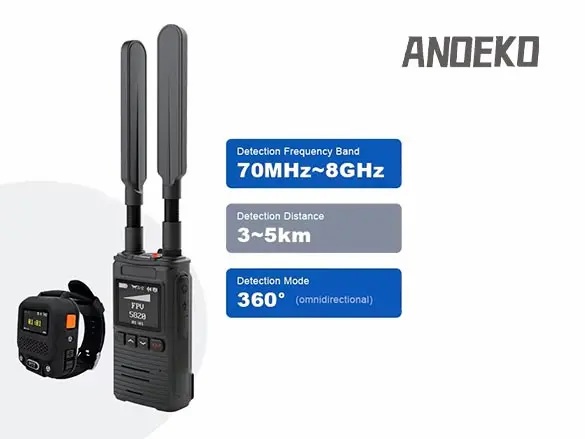
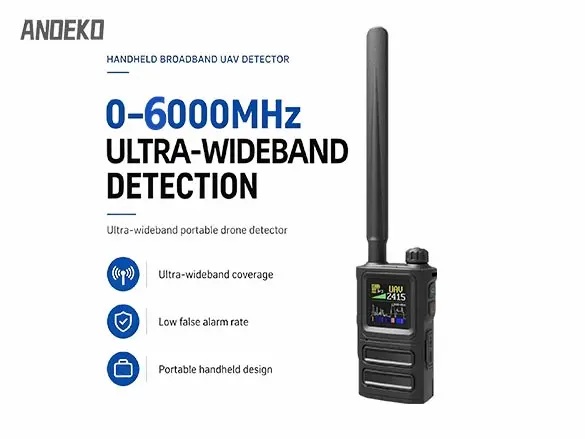
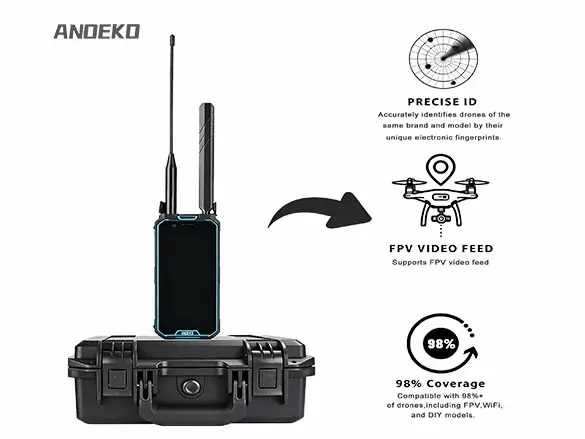
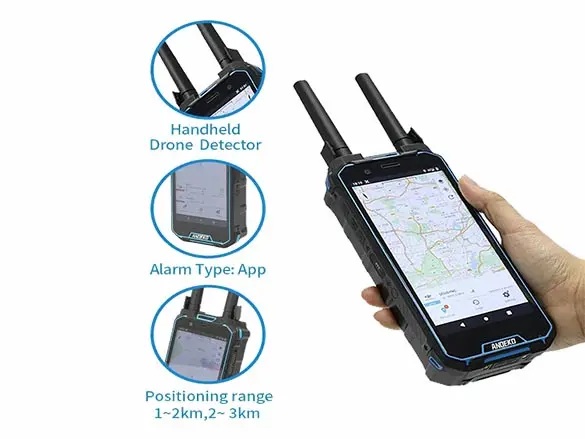
Reliable C‑UAS begins with detection. High‑frequency radar systems (including 3D AESA radars) not only detect small drones but also track their flight path with high precision. To complement active radar, passive RF direction finders and acoustic sensors are used to locate drones based on their communication signals. ANOEKO offers a layered detection suite that fuses radar, RF scanners, and thermal cameras, ensuring early warning even against GPS‑denied or autonomous drones.
Instead of shooting down every drone, some assets can be hardened against detection. Nanomaterial coatings applied to vehicles, command posts, or radar installations absorb or reflect drone‑emitted radar waves, significantly reducing the asset’s radar cross‑section (RCS). This passive countermeasure makes it harder for enemy UAVs to locate and lock onto high‑value targets. ANOEKO’s research division has tested ceramic‑based nanocomposite paints that also withstand harsh battlefield conditions.
Most drones rely on GNSS (GPS/GLONASS/Galileo) for stable flight. Portable GPS jammers emit strong signals on L1/L2 bands, overpowering satellite signals and causing the drone to lose orientation. More sophisticated deception devices – also part of ANOEKO’s electronic warfare portfolio – can inject false navigation data, leading the drone astray or triggering its “lost link” return‑to‑home function toward a trap zone.
A rising frontier in counter‑drone warfare is cyber‑kinetic engagement. By exploiting vulnerabilities in a drone’s data link or ground control software, military cyber operators can gain remote access – disabling the UAV, stealing its footage, or even forcing it to land safely. Network attacks include protocol fuzzing, deauthentication floods, and hijacking of the telemetry stream. Several ANOEKO‑backed cyber‑C‑UAS prototypes have successfully demonstrated “fly‑away” prevention and hostile drone recovery.
For threats operating above 10,000 feet (e.g., reconnaissance drones or loitering munitions en route), vertical launch interceptors mounted on mobile platforms provide area defense. These systems use thrust‑vectoring or boosted missiles to rapidly climb and engage fast‑moving targets with blast‑fragmentation warheads. ANOEKO’s engineering team has contributed to lightweight interceptor canisters that fit into standard weapon stations, offering high‑altitude coverage without dedicated air defense vehicles.
No single countermeasure works against every drone. A modern military unit needs layered defense – electronic jamming first, then directed energy or guns, and finally interceptors for the most persistent threats. Companies like ANOEKO are leading this integration by providing open‑architecture C‑UAS suites that combine detection, electronic attack, kinetic options, and passive protection.
As drone technology evolves – with AI‑enabled swarms, fiber‑optic controlled UAVs, and stealth designs – counter‑drone technology must advance just as fast. The solutions described above, many of which are already fielded or in advanced trials, represent the state of the art. By embedding brands like ANOEKO into continuous R&D pipelines, modern armed forces can secure their manoeuvre units, forward bases, and critical infrastructure against the growing aerial menace
Consultation Hotline
+86 18948793112
Email:lisen1205@foxmail.com
Mobile:+86 18948793112
WhatsApp:+86 18948793112
Address:Changchun North Road, Gongming Street, Guangming District, Shenzhen, China
Copyright © 2002-2026 Anoeko Technology Co., Ltd. All Rights Reserved. | Anti-Drone & Low-Altitude Defense Experts ICP:ICP